
Attio
Automation
9 minutes
Attio Workflows: how to automate your CRM in 2026?
Today, Attio Workflows allows you to automate a large part of CRM processes directly within Attio: lead qualification and assignment, opportunity updates, task creation, sales sequences, API calls, or AI analysis. It is therefore no longer necessary to systematically add Make, Zapier, or n8n. The real question is rather to know how far to stay within Attio and at what point an external layer really becomes useful.

Nadir BOUSSETTA
Updated on
What is an Attio Workflow?
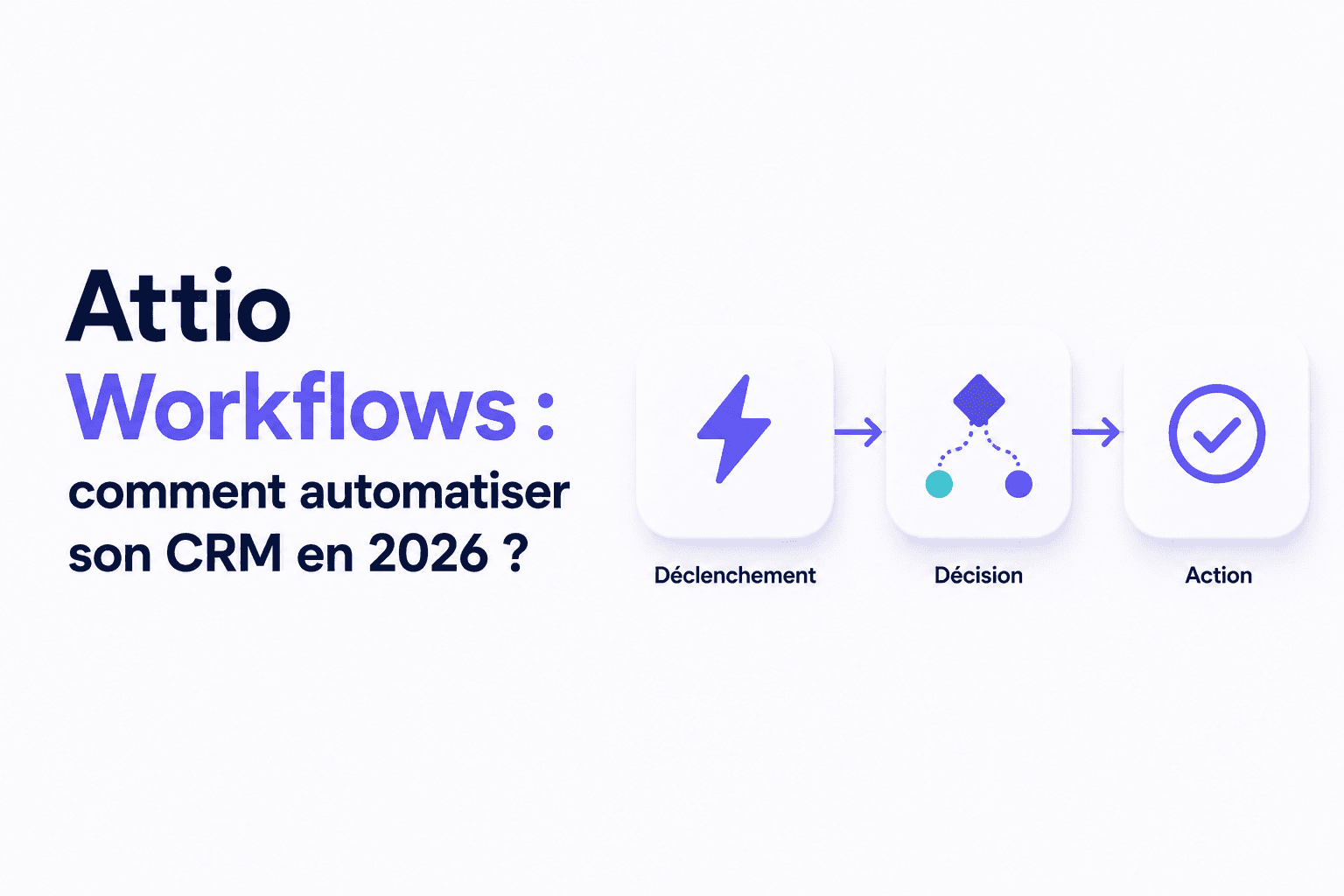
An Attio Workflow automates a process based on simple logic:
trigger → logic → action
A created record, an attribute change, a task, a note, a scheduled date, a webhook, or a manual action can trigger the process. The Workflow can then apply conditions, look up data, wait for a delay, or split records before executing an action: modifying the CRM, creating a task, enrolling a contact in a Sequence, calling an API, running JavaScript, or using a connected app.
Attio deeply evolved this engine in 2026. Current Workflows notably support more logic, AI agents, and Ask Attio to build automation using natural language. The official Attio Workflows documentation provides details on the available blocks.
This wealth of options does not mean everything should be automated. A Workflow remains most reliable when it corresponds to a clear process and uses the simplest possible technical layer.
What can be automated directly within Attio?
The native scope now covers many commercial processes.
Need | Native Attio |
|---|---|
Update a record or an opportunity | Yes |
Create and assign tasks | Yes |
Modify a status or pipeline stage | Yes |
Route leads | Yes |
Trigger a Sequence | Yes |
Apply conditions and branches | Yes |
Calculate certain data | Yes, particularly with Formula attributes |
Interpret information with AI | Yes |
Call an external API | Yes |
Run a JavaScript transformation | Yes |
Use certain third-party apps | Yes |
Orchestrate multiple complex systems | Possible, but not always desirable |
Formula attributes, for example, allow you to calculate a lead score, a weighted pipeline value, or an alert on an inactive opportunity. They are currently available on Pro and Enterprise plans. Our guide to Attio pricing and plans details the features and credits to consider based on your subscription.
Attio is also progressively enriching its App Store: Asana, for example, can receive projects or tasks from a Workflow, while Hunter allows you to search for or verify email addresses.
So the question is no longer just “Can Attio automate this process?”, but:
What is the simplest architecture to automate it correctly?
1. New lead: qualify and assign directly within Attio
Let's look at a classic case: a new prospect arrives in Attio after filling out a form.
The process can follow this logic:
new lead → qualification → score → routing rules → assignment → next action
If the necessary information is already in Attio, the Workflow can remain entirely native. Industry, company size, source, country, contact role, or a calculated score can power the assignment rules.
A Formula attribute can, for example, calculate the score, and the Workflow can then decide the next steps: assign a high-priority prospect to a sales representative, create a task, or direct a less mature lead to another process.
Adding Make or n8n solely to execute:
Attio → check score → choose owner → Attio
creates an extra dependency without solving a new problem.
An external layer becomes relevant when the decision actually requires data missing from the CRM: product data, data warehouse, proprietary tool, or multiple sources to consolidate.
Even before setting up this type of automation, you must define what actually makes a prospect relevant. Our guide on B2B lead qualification details this first step, while the one dedicated to B2B lead scoring explains how to turn certain criteria into a score without building an unnecessarily complex model.
2. Exploiting sales notes: when AI becomes useful
Workflows can now be triggered automatically when a note is created, or manually from a note.
However, a small nuance matters: for a note created manually in Attio, the Note created trigger fires as soon as it is created, before its content is necessarily finished. If the Workflow needs to interpret the final summary, using Note action once the note is finished — or planning an appropriate delay — is more reliable.
Imagine that after a meeting, a sales rep writes:
Prospect wants to move forward, but needs to validate the budget with their partner. Reconnect in early September to prepare a proposal.
A classic condition can easily handle:
Stage = Qualified
or:
Amount > €20,000
However, it cannot naturally interpret the note to extract intent, the next step, or the follow-up date.
An AI agent can here transform this text into structured data. The Workflow then resumes with deterministic actions: completing certain attributes, creating a task, or directing the opportunity.
The distinction is important.
If prospect is in France → France owner
A rule is enough.
Understand a summary to determine the next action
AI can be relevant.
Attio currently offers several AI capabilities in its Workflows, including classification, search functions, and Custom Agents. Our guide on Attio MCP and AI details the difference between Workflows, agents, Ask Attio, and MCP.
The right principle remains simple:
Use a rule when a rule is enough; reserve AI for information that actually needs to be interpreted.
3. Won deal: should you stay in Attio or move to operations?
Moving an opportunity to Closed Won is probably the most interesting case for deciding how far to use Attio.
Once the sale is complete, you sometimes need to create onboarding tasks, hand over information to delivery, initialize a project, generate documents, or notify multiple teams.
If post-sales remains simple: stay in Attio
A company with a light onboarding process can easily continue in Attio. The Workflow creates tasks, changes account status, sets a deadline, and assigns an owner.
Creating a second system just because the opportunity is won would add an unnecessary break.
If delivery works in a connected app
If the team already works in Asana and native blocks cover the need, the process can remain simple:
Closed Won → Attio Workflow → create Asana project
Using Make solely to link these two steps is not necessarily useful in this case.
If operations are structured in Airtable
In many service companies, a separation can be cleaner:
Attio → CRM / Revenue
Airtable → delivery / operations
Attio keeps accounts, contacts, and opportunities. Airtable manages projects, services, resources, or other operational processes after the sale.
This is a possible architecture, not a rule. If delivery fits well in Attio, there is no reason to move the process.
When separation is relevant, a simple HTTP request from the Workflow can sometimes suffice:
Closed Won → HTTP → Airtable API → create project
If, on the other hand, the same event must create an Airtable project, generate a Drive folder structure, transform multiple data points, create a document, and notify different systems, Make or n8n begin to have a real orchestration role.
This logic aligns with our approach to RevOps: each system should maintain a clear role rather than trying to replicate the entire company in the CRM.
Attio Workflow, HTTP, Make, n8n, or API: which to choose?
The choice depends less on what is technically possible and more on the responsibility of the process.
Situation | Preferred Choice |
Automation only within the CRM | Attio Workflow |
Interpretation of unstructured information | Workflow + AI |
Small deterministic transformation | Workflow + code |
One-off call to an external API | Workflow + HTTP |
Application covered by an adapted block | Native app |
Multiple systems and complex branches | Make / n8n |
Critical or high-volume synchronization | API + webhooks |
Feature deeply integrated into Attio | App SDK |
The HTTP block is very practical for occasionally sending or retrieving data. It becomes less suitable when you need to manage continuous synchronization, large volumes, complex retries, or monitoring independent of the CRM.
The same logic applies to JavaScript: a few lines of transformation can stay in the Workflow. A major, critical integration or one reused by multiple systems generally deserves a dedicated architecture.
Our Attio API guide details these technical cases, while our guide to Attio integrations covers the different ways to connect the CRM to the rest of the stack.
The rule to remember:
Start in Attio. Add a technical layer only when it solves a real problem.
Where does AI actually add value?
The presence of agents directly in Workflows might make you want to replace many rules with AI. This is generally not desirable.
A classic condition remains preferable for:
assigning by territory;
verifying an amount;
waiting for a delay;
comparing a score;
modifying a status.
AI becomes more interesting for:
interpreting a note;
qualifying a free-form response;
searching for information;
extracting the next steps of an exchange;
classifying a request.
This choice improves both predictability and maintainability. A critical decision should not become probabilistic simply because an AI agent is available.
Limits to know before automating
The new Workflows are available on all Attio plans, but their executions use workspace credits. In the current engine, triggers, logic, and data lookups are free; blocks that write data, communicate externally, or use AI can consume credits.
Attio details this logic precisely in its documentation on workspace credits.
So you need to think in terms of volume. An action executed twenty times a month and the same action triggered on several thousand records do not have the same impact.
Reliability should also be planned right from the design stage: unavailable APIs, missing data, execution errors, or ambiguous AI responses. Attio allows you to view runs and receive notifications in case of failure, but this is no substitute for an understandable architecture.
A Workflow that works technically is not necessarily a good Workflow.
How to keep Attio Workflows maintainable?
A few principles are generally enough.
Stabilize the process before automating it
Automation won't fix a poorly defined pipeline. If sales reps do not have the same definition of a qualified opportunity or the next step, it is better to resolve this issue before adding more logic to the CRM.
Stay native as long as native is enough
An action that can be performed cleanly with a few Attio blocks generally does not deserve a Make scenario, a server, and several extra connections.
Separate responsibilities
Several short Workflows are often easier to understand than an automation that manages qualification, follow-ups, onboarding, and reporting in the same canvas.
Plan for exceptions
A contact might not have a company, an API might be unavailable, and an AI might produce an ambiguous response. The nominal path should not be the only planned scenario.
Keep human validation when the decision is sensitive
AI can prepare a summary or suggest a classification. For a critical change — amount, commercial commitment, or sensitive external action — human validation may still be preferable.
This is also a central point during an Attio implementation: the goal is not to accumulate automations, but to build a CRM that the team understands, uses, and can evolve.
Frequently Asked Questions on Attio Workflows
Are Attio Workflows available on all plans?
Yes. The current Workflows engine is available on all plans. However, the volume of included credits depends on the subscription, and certain features used around Workflows, such as Formula attributes, currently require Pro or Enterprise.
Can Attio Workflows replace Make or n8n?
For many Attio-centric automations, yes: routing, tasks, updates, conditions, sequences, or HTTP calls can remain within the CRM. Make or n8n become more relevant when you need to orchestrate multiple systems, perform more complex transformations, or manage automation independently of Attio.
Can you use AI in Attio Workflows?
Yes. Attio offers several AI blocks and agents. They are most relevant for researching, interpreting, or structuring unstructured information. A deterministic business rule is still preferable when it suffices.
What is the difference between an Attio Workflow and a Sequence?
A Workflow orchestrates a process starting from an event and can modify data, create tasks, apply conditions, or call other systems. A Sequence is specifically used to chain sales emails. A Workflow can therefore enroll a contact into a Sequence when the right conditions are met.



Are your tools not running at full capacity?
CRM Implementation
Airtable business tools
Automation & AI
100+ companies supported






Need to go further on this topic?
Explain to us how you operate and the difficulties you are facing. No need for specifications: a few pieces of context are enough to get started.
" width="1200px"/><path d="M 266.535 16.032 C 223.973 8.761 187.735 7.632 157.11 11.498 C 103.429 18.273 67.035 40.432 43.86 71.713 C 20.585 103.127 10.454 143.889 9.417 187.627 C 8.842 211.814 11.054 236.889 15.354 261.795 L 5.904 261.795 C 1.673 236.82 -0.483 211.689 0.092 187.408 C 1.173 141.877 11.842 99.277 36.379 66.156 C 61.017 32.908 99.448 9.382 155.923 2.257 C 187.042 -1.678 223.673 -0.611 266.535 6.589 Z" fill="rgb(255, 255, 255)" height="261.79526125615695px" id="EOQRdtWnD" transform="translate(933.465 538.211)" width="266.5353197890507px"/><path d="M 422.36 47.835 C 396.36 45.858 367.779 40.81 336.21 31.96 C 262.11 11.188 203.266 5.673 157.116 11.496 C 103.429 18.271 67.041 40.43 43.866 71.711 C 20.591 103.123 10.46 143.888 9.423 187.627 C 8.098 243.465 21.585 304.027 41.535 356.315 C 47.185 371.127 51.979 386.052 55.785 400.908 L 46.166 400.908 C 42.554 387.171 38.073 373.377 32.835 359.658 C 12.491 306.327 -1.259 244.502 0.091 187.403 C 1.173 141.871 11.841 99.27 36.379 66.15 C 61.016 32.902 99.448 9.378 155.923 2.251 C 203.26 -3.722 263.341 1.86 338.716 22.987 C 369.379 31.585 397.135 36.461 422.354 38.33 Z" fill="rgb(255, 255, 255)" height="400.9083347098903px" id="CM5yVI9tH" transform="translate(777.641 399.098)" width="422.36004607987206px"/><path d="M 578.177 13.167 C 527.702 52.212 451.402 69.48 336.208 37.189 C 262.108 16.418 203.264 10.902 157.108 16.726 C 103.427 23.5 67.039 45.659 43.858 76.94 C 20.583 108.352 10.458 149.118 9.421 192.856 C 8.096 248.693 21.577 309.256 41.527 361.546 C 62.183 415.693 71.477 471.281 62.121 519.887 C 60.477 528.5 58.189 536.978 55.277 545.249 L 45.364 545.249 C 48.671 536.449 51.221 527.374 52.977 518.137 C 61.983 471.356 52.908 417.524 32.833 364.888 C 12.489 311.561 -1.262 249.738 0.092 192.636 C 1.17 147.106 11.839 104.502 36.383 71.384 C 61.014 38.136 99.446 14.611 155.921 7.484 C 203.258 1.511 263.339 7.092 338.714 28.22 C 454.514 60.682 529.577 41.144 578.177 0 Z" fill="rgb(255, 255, 255)" height="545.2493750000006px" id="quewpegSi" transform="translate(621.824 254.751)" width="578.1767758588476px"/><path d="M 1096.837 0 C 1063.719 98.523 981.369 194.7 779.037 137.981 C 704.944 117.211 646.094 111.695 599.944 117.519 C 546.26 124.293 509.872 146.452 486.695 177.733 C 463.42 209.146 453.289 249.911 452.252 293.649 C 450.928 349.487 464.414 410.049 484.361 462.339 C 505.019 516.489 514.311 572.072 504.956 620.677 C 499.756 647.675 488.835 672.506 470.949 693.756 C 453.107 714.956 428.391 732.525 395.589 745.037 C 329.823 770.125 231.269 774.9 89.979 747.719 C 57.387 741.45 27.484 734.869 0 728.075 L 0 718.544 C 27.914 725.444 58.369 732.156 91.726 738.575 C 231.162 765.412 328.006 760.844 392.248 736.337 C 423.508 724.412 446.977 707.775 463.828 687.756 C 480.636 667.787 490.913 644.4 495.814 618.933 C 504.817 572.149 495.747 518.321 475.667 465.682 C 455.324 412.355 441.575 350.533 442.934 293.429 C 444.012 247.897 454.684 205.296 479.223 172.176 C 503.857 138.928 542.289 115.404 598.764 108.277 C 646.1 102.304 706.181 107.886 781.556 129.013 C 973.65 182.864 1053.675 93.671 1086.656 0.001 L 1096.837 0.001 Z" fill="rgb(255, 255, 255)" height="766.0781015089856px" id="uOoHbsmVz" transform="translate(0.001 0)" width="1096.837499999949px"/><path d="M 821.268 0 C 774.037 19.125 711.137 22.727 627.518 0 L 669.212 0 C 716.174 8.62 755.468 7.761 788.249 0 Z M 374.848 0 C 356.714 10.202 342.212 23.319 330.874 38.619 C 307.6 70.031 297.466 110.8 296.432 154.533 C 295.108 210.371 308.593 270.933 328.541 323.222 C 349.199 377.373 358.491 432.956 349.136 481.563 C 343.936 508.559 333.014 533.391 315.129 554.64 C 297.286 575.84 272.571 593.407 239.769 605.92 C 184.744 626.913 106.758 633.681 0 619.411 L 0 610.027 C 105.685 624.304 182.533 617.787 236.428 597.227 C 267.688 585.301 291.157 568.66 308.008 548.64 C 324.816 528.673 335.093 505.283 339.993 479.818 C 348.998 433.033 339.926 379.206 319.846 326.568 C 299.504 273.241 285.754 211.417 287.108 154.316 C 288.186 108.786 298.859 66.182 323.397 33.064 C 332.843 20.282 344.299 9.116 357.319 0 Z" fill="rgb(255, 255, 255)" height="626.9607820564861px" id="lc1D1RSUL" transform="translate(0.001 0)" width="821.2681884765623px"/><path d="M 141.374 0 C 140.986 5.133 140.732 10.274 140.612 15.42 C 139.29 71.259 152.774 131.82 172.722 184.111 C 193.379 238.26 202.671 293.844 193.316 342.449 C 188.116 369.446 177.196 394.278 159.309 415.527 C 141.467 436.727 116.751 454.293 83.95 466.807 C 60.35 475.812 32.514 482.201 0 485.435 L 0 476.095 C 31.217 472.917 57.944 466.761 80.608 458.112 C 111.867 446.187 135.334 429.544 152.19 409.526 C 168.996 389.558 179.274 366.167 184.175 340.701 C 193.177 293.919 184.107 240.091 164.027 187.452 C 143.684 134.133 129.935 72.301 131.288 15.2 C 131.406 10.128 131.65 5.06 132.021 0 Z" fill="rgb(255, 255, 255)" height="485.4349999999995px" id="ryUOsw6P8" transform="translate(0 0)" width="196.9605581159212px"/></g></g></svg>)