
CRM
RevOps
10 minutes
B2B lead qualification: how to build an effective process?
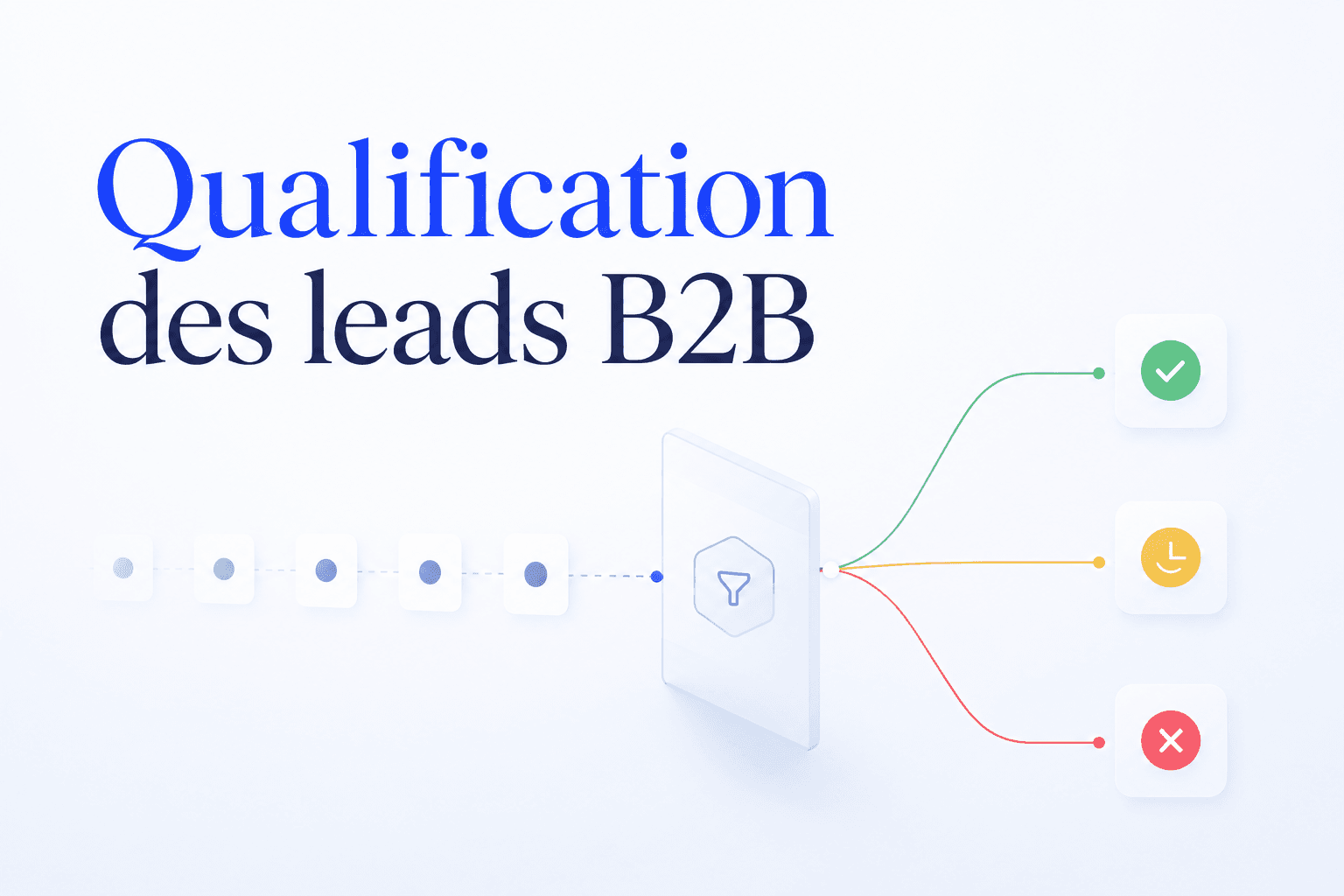
Qualifying a B2B lead consists of determining if they genuinely deserve sales time and what the next action should be. The goal is therefore not to fill as many fields as possible in a CRM, but to gather enough information to decide: proceed, create an opportunity, postpone the matter, or disqualify the lead.

Nadir BOUSSETTA
Updated on
What is B2B lead qualification?
A new contact is not automatically a business opportunity.
A person can fill out a form, download a resource, or be identified by a sales team while still being very far from making a purchase. Qualification gradually makes it possible to distinguish:
Lead → qualified lead → opportunity
A lead is an identified contact or company.
A qualified lead fits your target well enough and shows signals that justify taking it further.
An opportunity exists when a sufficiently concrete business project deserves to be tracked in the pipeline.
This distinction particularly avoids filling the pipeline with companies that match your target but have no identified problem, no priority, or no real project.
A company can perfectly match your ICP without being an opportunity today.
What criteria should be used to qualify a lead?
There is no universal grid. The right criteria depend on your offering, your sales cycle, and the complexity of the decision.
For a consultative B2B sale, six dimensions nevertheless constitute a good foundation.
Criterion | What we are really trying to understand |
|---|---|
Fit | Does this company match the type of client we can actually serve well? |
Problem | Is there a concrete problem that our offering can address? |
Impact | Does this problem have enough consequences to justify action? |
Priority | Why should the issue be addressed now rather than in six months? |
Decision | Who participates in the decision and how will it be made? |
Buying Power | Is the project economically realistic? |
All of these criteria do not necessarily have to become mandatory fields in the CRM.
The fit, for example, can often be evaluated from factual data: activity, company size, location, contact role, or type of need.
The problem and its impact require more context. A prospect who wants to "improve their CRM" may simply find their tool slightly unpleasant or lose several hours each week re-entering information while leaving opportunities unfollowed. The project does not have the same importance in both situations.
Priority then makes it possible to distinguish a recognized problem from a problem that the company is actually ready to address.
This is often where qualification becomes useful: when we understand not only if the prospect matches our target, but also why they might make a decision.
BANT, SPICED, or MEDDIC: which framework to choose?
Qualification frameworks provide a common structure to sales teams. They prevent each opportunity from being evaluated solely on intuition.
They should not, however, become a checklist mechanically applied to every meeting.
BANT: a simple grid
BANT is based on four criteria:
Budget — Authority — Need — Timeline
The framework is easy to understand and can be sufficient for a relatively simple sale.
Its limitation is that it can push to look for a budget, a decision-maker, and a deadline very early on, while the prospect is sometimes still trying to understand their problem. The absence of a defined budget at the first meeting does not necessarily mean that no project exists.
SPICED: understanding why the customer should act
SPICED is based on:
Situation — Pain — Impact — Critical Event — Decision
The approach starts with the prospect's context and their problem, then seeks to understand its impact, the event that makes the change a priority, and how the decision will be made.
For consultative B2B sales, this logic is particularly interesting: it helps to understand why the customer should change, rather than simply checking if they meet a series of criteria.
The information collected can also remain useful after the sale. The initial problem, the desired impacts, or the project objectives are, for example, valuable for handing over context to the teams responsible for onboarding or customer success.
MEDDIC: for more complex sales cycles
MEDDIC and its variations like MEDDPICC go deeper into the buying process: metrics, economic buyer, decision criteria, internal champion, competition...
This depth makes total sense on complex sales involving multiple stakeholders and long cycles.
For an SME selling a service with two contacts and a cycle of a few weeks, replicating MEDDPICC entirely in the CRM may, on the other hand, create more data entry than value.
The best framework is not the most comprehensive one. It is the one that allows for better sales decisions without turning every opportunity into an administrative form.
When should you qualify a lead?
Qualification is generally built in several steps.
Before the first interaction, the information already available makes it possible to evaluate part of the fit: company, activity, role, source of the lead, or information submitted in the form.
Anything that can be obtained automatically and reliably does not necessarily need to be asked of the prospect.
During the interaction, the main objective is to understand what data alone cannot determine: the problem, its impact, its priority, and the decision context.
After the interaction, qualification must lead to an action:
create or advance an opportunity;
place the lead in nurturing if the timing is not right;
disqualify the lead;
continue qualification if a truly decisive piece of information is still missing.
A qualification process that never changes the next action remains essentially a data collection exercise.
How to structure qualification in your CRM?
This is often where systems become unnecessarily complex.
A team adopts BANT, SPICED, or MEDDIC and then turns each element of the framework into multiple properties. A few months later, a record contains thirty fields that sales reps fill out partially or only because they are mandatory.
The problem does not come from the framework, but from its translation into the system.
Separating factual data from sales judgment
Some information is relatively objective:
industry;
number of employees;
lead source;
contacts;
estimated amount;
known timeline.
Others require interpretation:
importance of the problem;
priority level;
quality of the fit;
likelihood of closing.
This distinction matters when starting to automate the process.
A factual data point can be enriched or verified automatically. An assessment coming from a sales conversation requires more context and does not necessarily benefit from being turned into an automatic score.
Only making necessary fields mandatory
A field should not become mandatory simply because the information would be interesting to know.
The right question is rather:
Do we need this information to make the next decision?
Before moving an opportunity to an advanced stage, it may, for example, be relevant to require an identified problem, a next action, and a planned date.
Requiring an exact budget, a complete decision process, and all SPICED criteria right at lead creation is likely to encourage sales reps to enter inaccurate information.
This is an important principle when looking to structure qualification in your CRM: data quality also depends on the simplicity of the system requested from the teams.
Structuring disqualification reasons
A simple "Unqualified" status provides little information.
A few structured reasons, however, can become very useful:
out of target;
need not covered;
lack of priority;
incompatible budget;
bad timing;
no response;
chosen another solution.
This data then allows you to analyze why leads are not progressing and to identify any potential targeting, form, or sales process issues.
You shouldn't create twenty disqualification reasons from the start either. A few truly actionable categories are usually enough.
Always knowing the next action
An opportunity can be well qualified and still remain stuck for several weeks.
The CRM should make it easy to answer three questions:
Where does this opportunity stand?
What is the next action?
When is it scheduled to happen?
This simplicity often brings more value than a multiplication of scores and properties.
This is also one of the principles of a RevOps approach: structuring data and processes to help teams make better decisions, rather than simply accumulating information in the CRM.
Automating collection, not necessarily the decision
Part of the qualification can be automated.
A form can create the lead, some company information can be enriched automatically, and the CRM can assign the right owner, create a task, or flag that an important piece of information is missing.
With a flexible CRM like Attio, this logic can be integrated directly into the data model and sales workflows.
This does not mean that automation or an AI should decide on its own if an opportunity deserves to move forward.
When the decision depends on the context of a conversation, the expressed problem, or nuances specific to the project, keeping human validation usually remains more relevant.
The right CRM is therefore not the one that automates the most things. It is the one whose structure reflects the process well enough so that the team can use it without useless effort.
Qualification and lead scoring: what's the difference?
Qualification seeks to determine if a lead or an opportunity has the characteristics and context needed to move forward.
Lead scoring is used instead to prioritize leads based on different signals, such as their profile, behavior, or level of engagement.
A prospect can therefore get an excellent score because they perfectly match the ICP without having a current project.
Conversely, a company slightly outside the usual target may present an urgent problem that the offering addresses perfectly.
Scoring becomes particularly interesting when the volume of leads makes their prioritization difficult. With a low volume, a few simple qualification rules are often more useful than a sophisticated scoring model.
Example of a simple B2B qualification process
Let's take a service company receiving inquiries from its website.
1. Inbound form
The prospect fills in their identity, their company, and some details about their need.
↓
2. Enrichment
The system retrieves available information about the company when it actually brings value.
↓
3. Fit check
Does the company generally match the type of client the team can support?
↓
4. First call
The sales representative seeks to understand the problem, its impact, the priority, and the decision context.
↓
5. Qualification
The necessary information is saved in the CRM.
↓
6. Decision
→ Opportunity if the problem, the fit, and the project justify continuing.
→ Nurturing if the need exists but the timing is not right.
→ Disqualification if the company or the problem does not match.
The goal is not to design a perfect process immediately.
Start with a few criteria that actually change sales decisions. Then observe what information is missing, what no one uses, and the stages where opportunities get stuck.
The qualification process can then evolve with the CRM and the maturity of the team.
Frequently asked questions about B2B lead qualification
What is the difference between a qualified lead and an opportunity?
A qualified lead is a good match for your target audience and shows signs that justify taking things further. An opportunity corresponds to a project that is concrete enough to be tracked in the pipeline. Therefore, not all qualified leads are meant to immediately become opportunities.
How many criteria are needed to qualify a lead?
There is no ideal number. A few genuinely used criteria are better than a twenty-field grid filled in approximately. Start with the information needed to determine fit, understand the problem, and choose the next action.
Should you use BANT, SPICED, or MEDDIC?
It mostly depends on the complexity of the sale. BANT may be sufficient for a simple process, SPICED is particularly suited for a consultative approach centered on the problem and the impact, while MEDDIC or MEDDPICC make more sense for complex sales involving multiple stakeholders.



Are your tools not running at full capacity?
CRM Implementation
Airtable business tools
Automation & AI
100+ companies supported






Need to go further on this topic?
Explain to us how you operate and the difficulties you are facing. No need for specifications: a few pieces of context are enough to get started.
" width="1200px"/><path d="M 266.535 16.032 C 223.973 8.761 187.735 7.632 157.11 11.498 C 103.429 18.273 67.035 40.432 43.86 71.713 C 20.585 103.127 10.454 143.889 9.417 187.627 C 8.842 211.814 11.054 236.889 15.354 261.795 L 5.904 261.795 C 1.673 236.82 -0.483 211.689 0.092 187.408 C 1.173 141.877 11.842 99.277 36.379 66.156 C 61.017 32.908 99.448 9.382 155.923 2.257 C 187.042 -1.678 223.673 -0.611 266.535 6.589 Z" fill="rgb(255, 255, 255)" height="261.79526125615695px" id="EOQRdtWnD" transform="translate(933.465 538.211)" width="266.5353197890507px"/><path d="M 422.36 47.835 C 396.36 45.858 367.779 40.81 336.21 31.96 C 262.11 11.188 203.266 5.673 157.116 11.496 C 103.429 18.271 67.041 40.43 43.866 71.711 C 20.591 103.123 10.46 143.888 9.423 187.627 C 8.098 243.465 21.585 304.027 41.535 356.315 C 47.185 371.127 51.979 386.052 55.785 400.908 L 46.166 400.908 C 42.554 387.171 38.073 373.377 32.835 359.658 C 12.491 306.327 -1.259 244.502 0.091 187.403 C 1.173 141.871 11.841 99.27 36.379 66.15 C 61.016 32.902 99.448 9.378 155.923 2.251 C 203.26 -3.722 263.341 1.86 338.716 22.987 C 369.379 31.585 397.135 36.461 422.354 38.33 Z" fill="rgb(255, 255, 255)" height="400.9083347098903px" id="CM5yVI9tH" transform="translate(777.641 399.098)" width="422.36004607987206px"/><path d="M 578.177 13.167 C 527.702 52.212 451.402 69.48 336.208 37.189 C 262.108 16.418 203.264 10.902 157.108 16.726 C 103.427 23.5 67.039 45.659 43.858 76.94 C 20.583 108.352 10.458 149.118 9.421 192.856 C 8.096 248.693 21.577 309.256 41.527 361.546 C 62.183 415.693 71.477 471.281 62.121 519.887 C 60.477 528.5 58.189 536.978 55.277 545.249 L 45.364 545.249 C 48.671 536.449 51.221 527.374 52.977 518.137 C 61.983 471.356 52.908 417.524 32.833 364.888 C 12.489 311.561 -1.262 249.738 0.092 192.636 C 1.17 147.106 11.839 104.502 36.383 71.384 C 61.014 38.136 99.446 14.611 155.921 7.484 C 203.258 1.511 263.339 7.092 338.714 28.22 C 454.514 60.682 529.577 41.144 578.177 0 Z" fill="rgb(255, 255, 255)" height="545.2493750000006px" id="quewpegSi" transform="translate(621.824 254.751)" width="578.1767758588476px"/><path d="M 1096.837 0 C 1063.719 98.523 981.369 194.7 779.037 137.981 C 704.944 117.211 646.094 111.695 599.944 117.519 C 546.26 124.293 509.872 146.452 486.695 177.733 C 463.42 209.146 453.289 249.911 452.252 293.649 C 450.928 349.487 464.414 410.049 484.361 462.339 C 505.019 516.489 514.311 572.072 504.956 620.677 C 499.756 647.675 488.835 672.506 470.949 693.756 C 453.107 714.956 428.391 732.525 395.589 745.037 C 329.823 770.125 231.269 774.9 89.979 747.719 C 57.387 741.45 27.484 734.869 0 728.075 L 0 718.544 C 27.914 725.444 58.369 732.156 91.726 738.575 C 231.162 765.412 328.006 760.844 392.248 736.337 C 423.508 724.412 446.977 707.775 463.828 687.756 C 480.636 667.787 490.913 644.4 495.814 618.933 C 504.817 572.149 495.747 518.321 475.667 465.682 C 455.324 412.355 441.575 350.533 442.934 293.429 C 444.012 247.897 454.684 205.296 479.223 172.176 C 503.857 138.928 542.289 115.404 598.764 108.277 C 646.1 102.304 706.181 107.886 781.556 129.013 C 973.65 182.864 1053.675 93.671 1086.656 0.001 L 1096.837 0.001 Z" fill="rgb(255, 255, 255)" height="766.0781015089856px" id="uOoHbsmVz" transform="translate(0.001 0)" width="1096.837499999949px"/><path d="M 821.268 0 C 774.037 19.125 711.137 22.727 627.518 0 L 669.212 0 C 716.174 8.62 755.468 7.761 788.249 0 Z M 374.848 0 C 356.714 10.202 342.212 23.319 330.874 38.619 C 307.6 70.031 297.466 110.8 296.432 154.533 C 295.108 210.371 308.593 270.933 328.541 323.222 C 349.199 377.373 358.491 432.956 349.136 481.563 C 343.936 508.559 333.014 533.391 315.129 554.64 C 297.286 575.84 272.571 593.407 239.769 605.92 C 184.744 626.913 106.758 633.681 0 619.411 L 0 610.027 C 105.685 624.304 182.533 617.787 236.428 597.227 C 267.688 585.301 291.157 568.66 308.008 548.64 C 324.816 528.673 335.093 505.283 339.993 479.818 C 348.998 433.033 339.926 379.206 319.846 326.568 C 299.504 273.241 285.754 211.417 287.108 154.316 C 288.186 108.786 298.859 66.182 323.397 33.064 C 332.843 20.282 344.299 9.116 357.319 0 Z" fill="rgb(255, 255, 255)" height="626.9607820564861px" id="lc1D1RSUL" transform="translate(0.001 0)" width="821.2681884765623px"/><path d="M 141.374 0 C 140.986 5.133 140.732 10.274 140.612 15.42 C 139.29 71.259 152.774 131.82 172.722 184.111 C 193.379 238.26 202.671 293.844 193.316 342.449 C 188.116 369.446 177.196 394.278 159.309 415.527 C 141.467 436.727 116.751 454.293 83.95 466.807 C 60.35 475.812 32.514 482.201 0 485.435 L 0 476.095 C 31.217 472.917 57.944 466.761 80.608 458.112 C 111.867 446.187 135.334 429.544 152.19 409.526 C 168.996 389.558 179.274 366.167 184.175 340.701 C 193.177 293.919 184.107 240.091 164.027 187.452 C 143.684 134.133 129.935 72.301 131.288 15.2 C 131.406 10.128 131.65 5.06 132.021 0 Z" fill="rgb(255, 255, 255)" height="485.4349999999995px" id="ryUOsw6P8" transform="translate(0 0)" width="196.9605581159212px"/></g></g></svg>)