
CRM
RevOps
10 minutes
Quote-to-Cash: definition, process, and architecture
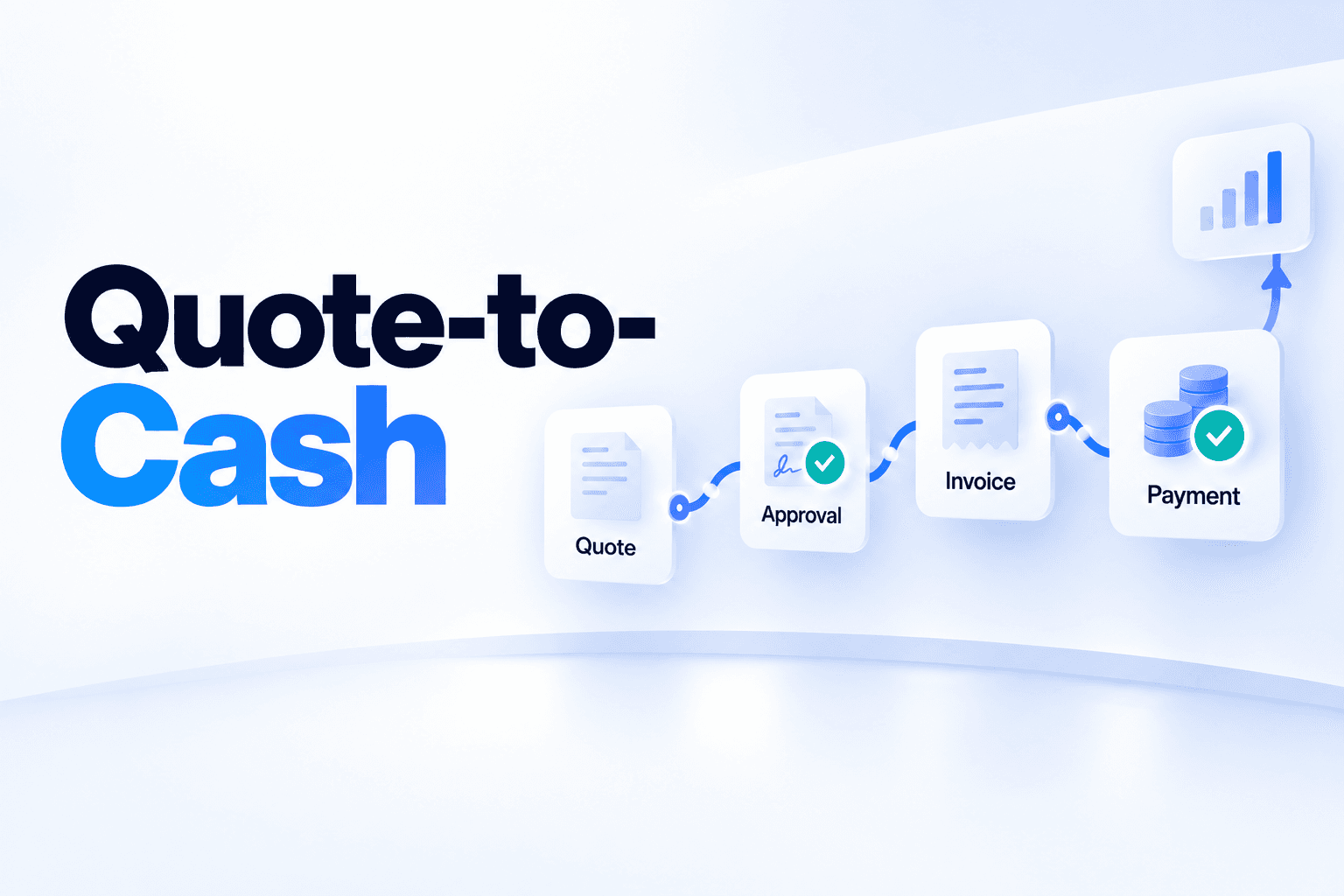
Quote-to-Cash, or Q2C, refers to the process that transforms a sales opportunity into collected revenue: offer configuration, quoting, validation, contract, invoicing and then payment, sometimes with delivery in between when it determines what can actually be invoiced. The real challenge is not to add a tool at each step, but to know which system holds which data, which information is authoritative, and which transitions must be automated. A good Quote-to-Cash can therefore fit into three simple tools or require a CPQ or a more structured operational system depending on the actual complexity of the business.

Nadir BOUSSETTA
Updated on
What is Quote-to-Cash?
Quote-to-Cash covers the journey that begins when the company concretely builds its commercial offer and ends when the corresponding revenue is invoiced and then collected.
A typical process might look like:
Opportunity → offer / pricing → quote → validation → signature → eventual execution → invoicing → payment
Not all companies need the same level of sophistication.
A service company that sells a few packages can generate its quotes from its CRM and then transmit the useful information to its billing tool.
A company with hundreds of configurations, multiple pricing models, guided discounts, and different approval levels will need a more structured architecture.
Quote-to-Cash therefore primarily describes a business process, not a software stack.
Quote-to-Cash vs Order-to-Cash
The main difference is at the beginning of the process.
Quote-to-Cash includes the building of the offer and the quote before the order.
Order-to-Cash generally starts once the order is placed and covers its processing through to invoicing and collection.
The ServiceNow documentation on Order-to-Cash highlights this distinction between upstream commercial activities and order processing.
Why Quote-to-Cash often breaks after closing
The commercial pipeline is generally highly visible: an opportunity advances until it is won or lost.
After the closing, the situation often becomes less clear.
The quote is prepared in a separate document. The negotiated terms remain in an email. Customer information is re-entered into the billing tool. The project starts with slightly different data than what was in the contract.
The problem especially appears when the same information has multiple versions.
A few frequent examples:
the amount changes in the CRM but not in the quote;
Finance has to ask the salesperson what was actually sold;
delivery is unaware of certain negotiated terms;
a completed service is never flagged as billable;
an invoice is generated twice;
the CRM indicates "won" without making it possible to know if the customer has been invoiced or paid.
Adding automations to this system is not enough.
You first need to clarify who is responsible for each piece of data and at what point it changes status.
The real issue: knowing which system is authoritative
A Quote-to-Cash architecture becomes much simpler when each piece of data has an identifiable source of truth.
Information | System that can be authoritative |
|---|---|
Opportunity and business relationship | CRM |
Sold offer | CRM or CPQ |
Complex configuration and pricing | CPQ |
Contractual commitment | Signed contract |
Realized / consumed / delivered | Delivery tool |
Invoice | Invoicing / accounting software |
Payment | Financial software / PSP |
Information can then be visible elsewhere.
The CRM can, for example, display that an invoice is paid. But this information should flow up from the financial system: it should not be manually modified in both tools.
This is an important difference between sharing data and duplicating its responsibility.
What does a simple Quote-to-Cash look like?
Let's take a service company that sells a few standardized flat-rate services.
At the time of closing, the CRM already contains:
the customer;
the offer;
the amount;
the main terms;
the scheduled start date.
The architecture can remain very short:
CRM → quote / signature → billing
Once the contract is signed, a few actions are enough:
create or update the customer in the billing tool;
prepare the invoice or its draft;
advance the opportunity in the CRM;
launch onboarding or create the project if necessary.
The status of the invoice and payment can then be sent back to the CRM if this information actually serves the Revenue teams.
In this case, adding a CPQ, Airtable, or an external automation platform does not necessarily create value.
The right architecture is the simplest one that correctly executes the process.
When delivery must enter the Quote-to-Cash
The model changes when the contract is not enough to determine what needs to be invoiced.
This is common in agencies, consulting firms, and service companies.
An opportunity can be signed for €20,000, while the invoicing must then follow:
a down payment;
several milestones;
validated deliverables;
consumed hours;
a credit pack;
an actually produced quantity;
additional services.
The contract then defines the commercial framework, but the delivery system produces the billable data.
The architecture can become:
CRM → contract → Airtable / business tool → billing
Let's take an agency.
The CRM keeps the opportunity, the contractual amount, and useful information for the customer relationship.
After signature, a project is created in the delivery tool. Each deliverable then has its own status: planned, in progress, delivered, validated, billable, billed.
When certain items become billable, they can automatically generate a draft invoice in Pennylane or another financial tool.
This is much more robust than assuming right from the closing that the entire value of the contract is immediately billable.
The CRM then does not need to store all tasks or deliverables. It can simply receive information useful to the business relationship: amount already invoiced, upcoming renewal, potential expansion, or major incident.
This is the same logic we apply when thinking about a CRM for agencies: connecting sales and operations without necessarily merging them.
When do you actually need a CPQ?
A CPQ — Configure, Price, Quote — mainly comes into play before the signature.
It is used to configure the offer, apply pricing rules, and produce the quote.
It can therefore be part of the Quote-to-Cash, but is not a mandatory step.
If a company sells five offers with a few options and a simple discount policy, the CRM may be enough.
The need for a CPQ becomes more credible when salespeople have to manage:
numerous product references;
incompatible configurations;
bundles;
multiple pricing models;
volume brackets;
guided discounts;
approvals;
complex renewals or expansions.
At this stage, maintaining rules in a few CRM fields, formulas, and automations becomes difficult to control.
The CPQ then absorbs real business complexity.
It should not create a new one.
CRM, Airtable, CPQ, and billing: who should do what?
Quote-to-Cash spans multiple functions. This does not mean a single tool should handle everything.
Need | Natural system | When to add another block |
|---|---|---|
Accounts, contacts, opportunities | CRM like Attio | when operations become too detailed |
Simple offer and pricing | CRM | when rules become difficult to maintain |
Complex configuration and pricing | CPQ | when this complexity actually exists |
Contract / signature | Signature tool | when a specific contractual workflow is required |
Delivery | Airtable or business tool | when actual realization conditions management or billing |
Invoicing | Pennylane / ERP / financial tool | to maintain a clear financial source |
Payment | Financial system / PSP | to push back only statuses useful to other teams |
Attio can, for example, remain the Revenue system where accounts, opportunities, and commercial interactions live.
Airtable can take over if delivery requires a true operational model: projects, services, deliverables, consumptions, or billable items.
But using both is not a goal in itself.
If Attio and the billing tool correctly cover the process, there is no reason to insert Airtable between the two.
Three Quote-to-Cash architectures based on need complexity
It is more useful to distinguish several architectures than to look for a universal Q2C stack.
1. Simple Q2C
CRM → quote / signature → billing
Relevant when:
the offer is simple;
the price is known at closing;
exceptions are rare;
the contract directly determines billing.
The main challenge is to eliminate re-entry and secure the transition between sales, contract, and Finance.
2. Delivery-driven Q2C
CRM → contract → business tool → billing
Relevant when:
the actual realization determines what becomes billable;
several milestones or deliverables exist;
consumption changes during the project;
sales and operations need different data models.
The operational tool then becomes the source of truth for the billable item, without replacing the CRM or the accounting software.
3. Q2C with complex commercial logic
CRM → CPQ → contract → ERP / billing
Relevant when the complexity lies before the closing:
configuration;
pricing;
discounts;
approvals;
contractual rules.
In this case, the CPQ avoids dispersing this logic across CRM, spreadsheets, and automations.
The system can evolve from one architecture to another.
It is generally healthier to start simple and add a block when real complexity appears rather than trying to anticipate all possible exceptions from the start.
What should be automated in a Quote-to-Cash process?
The most useful automations are generally found where responsibility shifts from one system or team to another.
For example:
signature → creation of the customer or project;
won deal → transmission of sold products;
validated deliverable → creation of a billable item;
billable → draft invoice;
issued invoice → CRM update;
received payment → Revenue information;
contract expiration → renewal opportunity.
These transitions deserve to be secured because an oversight has a concrete consequence.
Conversely, constantly synchronizing fifty fields across three tools rarely brings the same value.
A good question to ask for each automation is:
What manual re-entry, error, or business decision does this automation eliminate?
If the answer is not clear, it is probably not a priority.
This logic aligns more broadly with the RevOps approach: circulating the right information between teams rather than simply adding automations around the CRM.
Mistakes to avoid in Quote-to-Cash
Automating before defining the rules
If no one knows exactly when a service becomes billable, automating invoice creation solves nothing.
The system will simply execute an ambiguous rule faster.
Duplicating all data everywhere
A CRM does not need to know every task of a project.
A delivery tool does not need to reproduce the entire commercial history.
You need to synchronize data that triggers a decision or an action, not the entirety of systems.
Using CRM as a default delivery tool
A CRM can technically store tasks, deliverables, and consumptions.
The real question is whether it remains maintainable and understandable when operations become more complex.
Adding a CPQ too early
A few products, a few options, and a commercial discount do not automatically justify a CPQ.
A new block must absorb existing complexity.
Building a chain of automations with no recovery plan
In a financial process, a single failure can create a missing invoice or a duplicate.
So you need to think about:
controls;
logging;
recovery;
deduplication;
exception handling.
Robustness matters more than the number of automated steps.
Confusing signed, delivered, billable, invoiced, and paid
These five states are different.
A signed contract may require several months of delivery.
A completed deliverable may wait for validation.
A billable service may not yet have generated an invoice.
An issued invoice may remain unpaid.
Representing them correctly avoids many management and automation errors.
How to design your Quote-to-Cash process
Before choosing a stack, reconstruct the actual process.
1. Map out the steps
What actually happens between the commercial agreement and the payment?
Include validations, exceptions, and manual re-entries that exist today.
2. Define important states
For example:
proposed → signed → delivered → billable → invoiced → paid
These states do not necessarily have to live in the same system.
3. Choose sources of truth
Where do you modify the price?
What data proves a contract is signed?
Which system decides a deliverable is billable?
Where does the actual status of an invoice live?
4. Formalize business rules
When should you invoice?
Who can apply a discount?
How do you handle an amendment?
What happens in case of cancellation, credit note, or partial payment?
5. Design the minimal architecture
Start with tools already in place.
A new block is only relevant when a need remains poorly covered.
6. Automate critical transitions
Priority goes to passages that currently cause manual re-entry, an oversight, or an error.
7. Plan for exceptions
A system is only truly operational when a team can handle an unusual case without having to call the person who built it.
This is the same logic we apply during a CRM implementation: process and responsibilities first, configuration next.
Frequently Asked Questions on Quote-to-Cash
What is the difference between Quote-to-Cash and Order-to-Cash?
Quote-to-Cash begins right from the creation of the offer and the quote. Order-to-Cash generally starts once the order has been placed. Q2C therefore covers a broader part of the sales cycle.
Do you need a dedicated Quote-to-Cash software?
No. A CRM, a signature tool, and billing software may be enough for a simple process. A platform or specialized building blocks become useful when pricing, contracts, billing, or exceptions create real complexity.
What is the difference between CPQ and Quote-to-Cash?
CPQ primarily covers Configure, Price, Quote: product configuration, pricing, and quoting. Quote-to-Cash encompasses a broader process up to invoicing and payment.
Can a CRM handle the entire Quote-to-Cash process?
It can drive a large part of a simple process. But it is not necessarily the right place to manage detailed delivery, accounting, or complex pricing rules. The goal is not to centralize everything in the CRM, but to maintain clear responsibilities between systems.
How to automate Quote-to-Cash without complicating your stack?
Start with the transitions that currently result in re-entry, an error, or an omission: signature to onboarding, sold data to delivery, billable items to invoicing, payment to CRM. A few critical, controlled, and recoverable automations are generally more robust than a permanent synchronization of all data.



Are your tools not running at full capacity?
CRM Implementation
Airtable business tools
Automation & AI
100+ companies supported







Need to go further on this topic?
Explain to us how you operate and the difficulties you are facing. No need for specifications: a few pieces of context are enough to get started.
" width="1200px"/><path d="M 266.535 16.032 C 223.973 8.761 187.735 7.632 157.11 11.498 C 103.429 18.273 67.035 40.432 43.86 71.713 C 20.585 103.127 10.454 143.889 9.417 187.627 C 8.842 211.814 11.054 236.889 15.354 261.795 L 5.904 261.795 C 1.673 236.82 -0.483 211.689 0.092 187.408 C 1.173 141.877 11.842 99.277 36.379 66.156 C 61.017 32.908 99.448 9.382 155.923 2.257 C 187.042 -1.678 223.673 -0.611 266.535 6.589 Z" fill="rgb(255, 255, 255)" height="261.79526125615695px" id="EOQRdtWnD" transform="translate(933.465 538.211)" width="266.5353197890507px"/><path d="M 422.36 47.835 C 396.36 45.858 367.779 40.81 336.21 31.96 C 262.11 11.188 203.266 5.673 157.116 11.496 C 103.429 18.271 67.041 40.43 43.866 71.711 C 20.591 103.123 10.46 143.888 9.423 187.627 C 8.098 243.465 21.585 304.027 41.535 356.315 C 47.185 371.127 51.979 386.052 55.785 400.908 L 46.166 400.908 C 42.554 387.171 38.073 373.377 32.835 359.658 C 12.491 306.327 -1.259 244.502 0.091 187.403 C 1.173 141.871 11.841 99.27 36.379 66.15 C 61.016 32.902 99.448 9.378 155.923 2.251 C 203.26 -3.722 263.341 1.86 338.716 22.987 C 369.379 31.585 397.135 36.461 422.354 38.33 Z" fill="rgb(255, 255, 255)" height="400.9083347098903px" id="CM5yVI9tH" transform="translate(777.641 399.098)" width="422.36004607987206px"/><path d="M 578.177 13.167 C 527.702 52.212 451.402 69.48 336.208 37.189 C 262.108 16.418 203.264 10.902 157.108 16.726 C 103.427 23.5 67.039 45.659 43.858 76.94 C 20.583 108.352 10.458 149.118 9.421 192.856 C 8.096 248.693 21.577 309.256 41.527 361.546 C 62.183 415.693 71.477 471.281 62.121 519.887 C 60.477 528.5 58.189 536.978 55.277 545.249 L 45.364 545.249 C 48.671 536.449 51.221 527.374 52.977 518.137 C 61.983 471.356 52.908 417.524 32.833 364.888 C 12.489 311.561 -1.262 249.738 0.092 192.636 C 1.17 147.106 11.839 104.502 36.383 71.384 C 61.014 38.136 99.446 14.611 155.921 7.484 C 203.258 1.511 263.339 7.092 338.714 28.22 C 454.514 60.682 529.577 41.144 578.177 0 Z" fill="rgb(255, 255, 255)" height="545.2493750000006px" id="quewpegSi" transform="translate(621.824 254.751)" width="578.1767758588476px"/><path d="M 1096.837 0 C 1063.719 98.523 981.369 194.7 779.037 137.981 C 704.944 117.211 646.094 111.695 599.944 117.519 C 546.26 124.293 509.872 146.452 486.695 177.733 C 463.42 209.146 453.289 249.911 452.252 293.649 C 450.928 349.487 464.414 410.049 484.361 462.339 C 505.019 516.489 514.311 572.072 504.956 620.677 C 499.756 647.675 488.835 672.506 470.949 693.756 C 453.107 714.956 428.391 732.525 395.589 745.037 C 329.823 770.125 231.269 774.9 89.979 747.719 C 57.387 741.45 27.484 734.869 0 728.075 L 0 718.544 C 27.914 725.444 58.369 732.156 91.726 738.575 C 231.162 765.412 328.006 760.844 392.248 736.337 C 423.508 724.412 446.977 707.775 463.828 687.756 C 480.636 667.787 490.913 644.4 495.814 618.933 C 504.817 572.149 495.747 518.321 475.667 465.682 C 455.324 412.355 441.575 350.533 442.934 293.429 C 444.012 247.897 454.684 205.296 479.223 172.176 C 503.857 138.928 542.289 115.404 598.764 108.277 C 646.1 102.304 706.181 107.886 781.556 129.013 C 973.65 182.864 1053.675 93.671 1086.656 0.001 L 1096.837 0.001 Z" fill="rgb(255, 255, 255)" height="766.0781015089856px" id="uOoHbsmVz" transform="translate(0.001 0)" width="1096.837499999949px"/><path d="M 821.268 0 C 774.037 19.125 711.137 22.727 627.518 0 L 669.212 0 C 716.174 8.62 755.468 7.761 788.249 0 Z M 374.848 0 C 356.714 10.202 342.212 23.319 330.874 38.619 C 307.6 70.031 297.466 110.8 296.432 154.533 C 295.108 210.371 308.593 270.933 328.541 323.222 C 349.199 377.373 358.491 432.956 349.136 481.563 C 343.936 508.559 333.014 533.391 315.129 554.64 C 297.286 575.84 272.571 593.407 239.769 605.92 C 184.744 626.913 106.758 633.681 0 619.411 L 0 610.027 C 105.685 624.304 182.533 617.787 236.428 597.227 C 267.688 585.301 291.157 568.66 308.008 548.64 C 324.816 528.673 335.093 505.283 339.993 479.818 C 348.998 433.033 339.926 379.206 319.846 326.568 C 299.504 273.241 285.754 211.417 287.108 154.316 C 288.186 108.786 298.859 66.182 323.397 33.064 C 332.843 20.282 344.299 9.116 357.319 0 Z" fill="rgb(255, 255, 255)" height="626.9607820564861px" id="lc1D1RSUL" transform="translate(0.001 0)" width="821.2681884765623px"/><path d="M 141.374 0 C 140.986 5.133 140.732 10.274 140.612 15.42 C 139.29 71.259 152.774 131.82 172.722 184.111 C 193.379 238.26 202.671 293.844 193.316 342.449 C 188.116 369.446 177.196 394.278 159.309 415.527 C 141.467 436.727 116.751 454.293 83.95 466.807 C 60.35 475.812 32.514 482.201 0 485.435 L 0 476.095 C 31.217 472.917 57.944 466.761 80.608 458.112 C 111.867 446.187 135.334 429.544 152.19 409.526 C 168.996 389.558 179.274 366.167 184.175 340.701 C 193.177 293.919 184.107 240.091 164.027 187.452 C 143.684 134.133 129.935 72.301 131.288 15.2 C 131.406 10.128 131.65 5.06 132.021 0 Z" fill="rgb(255, 255, 255)" height="485.4349999999995px" id="ryUOsw6P8" transform="translate(0 0)" width="196.9605581159212px"/></g></g></svg>)