
Airtable
11 minutes
Airtable Frontend: which solution to choose in 2026?
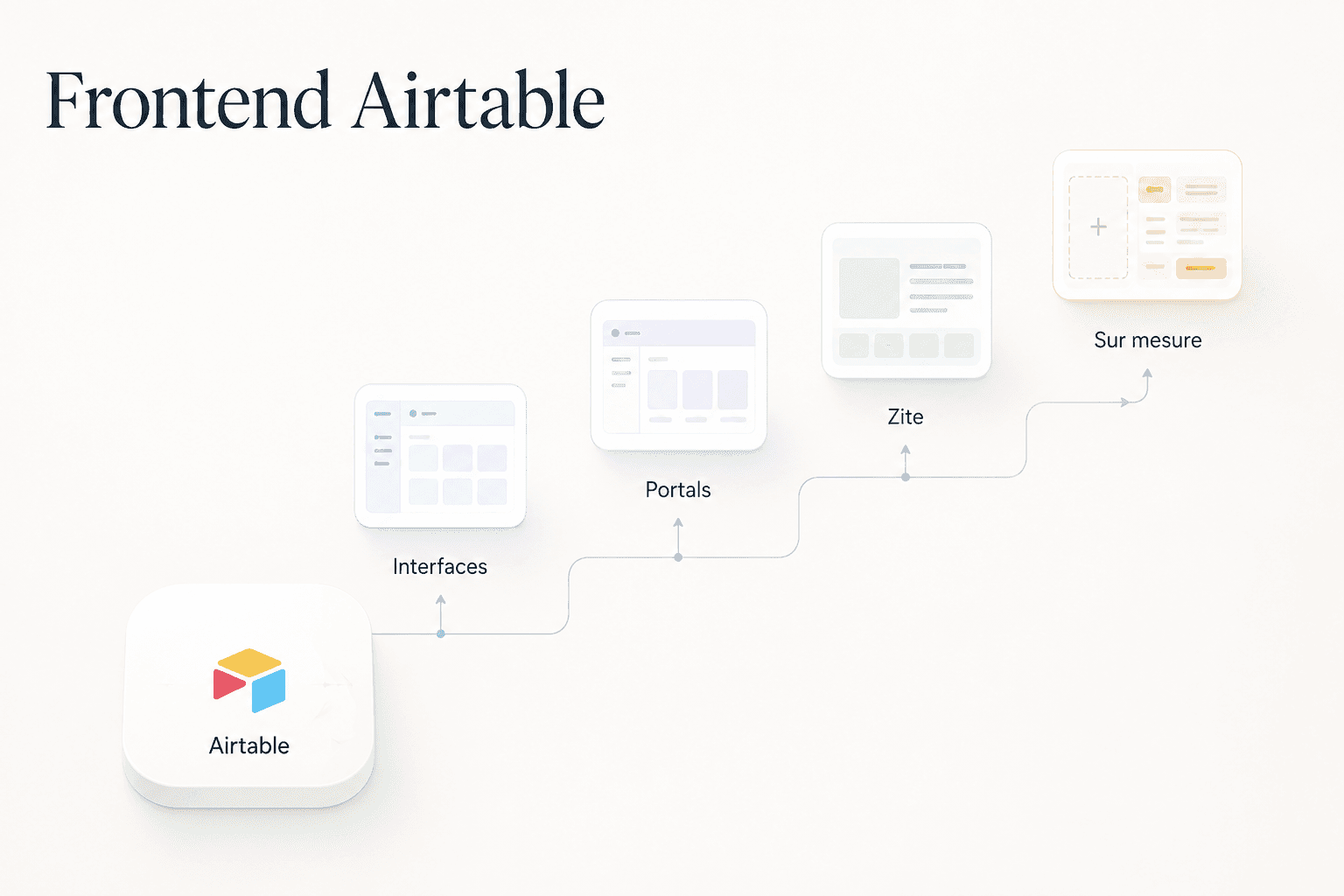
Airtable can manage the data and workflows of a business tool without necessarily being the interface used by everyone. For an internal team, Airtable Interfaces is often sufficient. For clients or partners, Portals now allows you to stay within Airtable. And when a true application experience becomes necessary, a frontend like Zite or a custom application can take over. The right choice depends less on the number of features available than on the experience your users actually need.

Nadir BOUSSETTA
Updated on
Which Airtable frontend to choose?
Before comparing the tools, we must distinguish several levels of architecture.
Need | Preferred solution | Why | Main compromise |
|---|---|---|---|
Internal tool for a team already working with Airtable | Airtable Interfaces | Native, simple, no additional layer | Customization limited to the Airtable framework |
Access for clients, suppliers or partners with a simple need | Airtable Portals | Allows staying entirely within Airtable | More constrained UX and customization |
More customized portal or application using Airtable data | Zite | Dedicated authentication, permissions and application experience | An extra platform to maintain |
Specific need that Zite does not address as well | Softr, Noloco or other frontend | Alternatives with their own components and permission models | Case-by-case comparison necessary |
Very specific application or major technical constraints | Bespoke frontend + Airtable API | Complete control over the experience and logic | Higher development and maintenance costs |
The rule we generally apply is simple:
Do not add an external frontend just to make Airtable look prettier.
If Airtable can already offer a sufficiently clear experience for users, staying native avoids an extra platform, synchronizations, and a maintenance layer.
An external frontend becomes interesting when it solves a real limitation: customer experience, authentication, navigation, customization, permissions, or specific application logic.
1. Airtable Interfaces: start with native for internal use
When Airtable is used as an internal business tool, Interface Designer should generally be the first starting point.
An Airtable base can quickly become difficult to use on a daily basis: numerous tables, technical fields, intermediate views, automations, or information that not every collaborator needs.
Interfaces allow building a much simpler layer on top of this structure.
In particular, you can create:
lists and galleries;
dashboards;
kanban views;
forms;
detailed sheets;
pages filtered according to the user;
buttons triggering actions or automations.
The goal is not to replicate the entire base in a new interface, but on the contrary to present each team only with the information and actions necessary for their work.
Example: internal project management tool
An agency uses Airtable to manage:
Clients → Projects → Tasks → Deliverables → Invoicing
The system potentially contains dozens of fields required for automations and steering.
A project manager, however, only needs to see:
their active projects;
upcoming deadlines;
overdue tasks;
deliverables to validate;
a few indicators.
An Interface can give them exactly this experience without creating a second application.
In this context, adding Zite or Softr would primarily bring another layer to maintain.
We detail the design of this native layer further in our guide on Airtable Interfaces.
When Airtable Interfaces start to show limits
The question changes when the user is no longer actually part of the team working in Airtable.
For example:
a client needs to track their project;
a supplier needs to submit information;
a partner needs to consult only certain files;
many users need to use an application without knowing Airtable.
You must then ask yourself if Airtable should remain visible in the user experience.
2. Airtable Portals: open Airtable to external users without adding another tool
Historically, creating a portal on top of Airtable quickly led to an external tool.
Airtable Portals changed part of this equation.
Portals allows giving external users — clients, suppliers, service providers or partners — access to certain Airtable Interfaces and only to the information that concerns them.
The system therefore remains:
Airtable → Interface → external user
without adding a second frontend.
Airtable notably allows using filters linked to the logged-in user to limit the visible records.
Example: client portal for an agency
Let's imagine the team manages its projects in Airtable.
Each client must be able to:
consult their projects;
track their progress;
download documents;
add certain information;
validate a deliverable.
If an Airtable Interface offers a sufficiently good experience, Portals is probably the first solution to test.
We keep a single data logic and a single interface layer.
The cost must nevertheless enter into the decision
Portals is an add-on.
As of August 2026, Airtable indicates pricing starting from:
$120/month for 15 Portal seats on Team;
$150/month for 15 seats on Business;
custom pricing on Enterprise Scale.
Users with read-only access are not counted as paid Portal seats.
These rates should be checked in the official Airtable documentation at the time of choice, as they may change.
This cost must above all be compared to the real cost of an external frontend, not just its subscription.
Adding Zite or Softr also involves configuration, a second platform and more maintenance.
When Portals is no longer enough
Portals remains built on Interface Designer.
If the goal is to offer a highly personalized experience, navigation specific to your product, a strong visual identity, or specific application flows, you eventually reach the natural limits of an Airtable Interface.
That is when a real external frontend becomes interesting.
We detail this first level of external access more precisely in our guide on the Airtable client portal.
3. Zite: when Airtable must become a real application
Zite represents a different approach.
Airtable continues to store and structure the data, but the user no longer works in an Airtable Interface.
The logic becomes:
User → Zite → Airtable
Zite connects directly to an Airtable base and allows building an application with its own pages, navigation, authentication and access rules.
The platform notably allows using Airtable data in a customized interface, managing users and permissions, creating forms and triggering workflows.
Example: a more advanced client portal
Let's take the same agency.
Its internal system remains in Airtable:
Clients → Projects → Tasks → Documents → Invoices
But it now wants to offer a more accomplished experience to its clients:
dedicated login;
customized home page;
navigation specific to its service;
different display depending on the client;
integrated forms;
specific actions;
more controlled visual identity.
The team can continue to work in Airtable Interfaces while clients use Zite.
We then obtain:
Team → Airtable Interfaces → Airtable ← Zite ← Clients
This architecture is often more relevant than forcing the internal team and clients to use the exact same interface.
Authentication and user management
An external frontend like Zite also allows separating application users from Airtable collaborators better.
For example, two logged-in users do not necessarily need to see the same data.
A client can consult only their own projects while an administrator accesses all files.
This permission logic becomes particularly important as soon as the frontend hosts multiple companies, roles or user categories.
Adding application logic
An external frontend is not just for displaying data differently.
Zite also features workflows that allow some of the application's logic to live outside of Airtable: data processing, calls to external services or actions triggered from the interface.
This capability becomes interesting when the application starts to go beyond the role of a simple portal.
But this is also the moment to be vigilant.
Zite adds a real layer to the system
Moving from:
Airtable
to:
Airtable + Zite
mechanically increases complexity.
You must now determine:
where each logic lives;
where permissions are managed;
what happens when an Airtable field changes;
which operations remain in Airtable Automations;
which operations must live in Zite;
how to diagnose a problem when a workflow fails.
That is why we would not recommend Zite simply because its interface is more customizable.
It must solve a constraint that the native Airtable layer does not solve properly.
4. What about Softr, Noloco and other Airtable frontends?
Zite is obviously not the only solution for building a frontend on top of Airtable.
Softr remains particularly popular for client portals and internal tools connected to Airtable, with mechanisms for authentication, user groups, and permissions.
Noloco or other builders may also be more suitable depending on available components, permission constraints, pricing or team habits.
But comparing fifteen builders feature by feature is rarely the best way to choose.
Once the need justifies an external frontend, we would rather look at a few specific criteria:
the desired user experience;
the necessary access rules;
the indispensable components;
the ease of connection to Airtable;
other data sources;
the necessary automations;
the cost according to the number of users;
the ease of maintenance.
If Zite cleanly covers these needs, there is no reason to add a long benchmark phase.
Conversely, a truly blocking constraint justifies looking at Softr, Noloco or another solution.
Business need → architecture → tool, and not the other way around.
5. When to move to a custom frontend?
There is an additional level:
Airtable → API → custom developed application
This approach gives much more freedom.
The application can have:
its own design system;
its own authentication;
its own user journeys;
complex business logic;
multiple data sources;
deep integrations with other systems.
Airtable can continue to serve as the operational layer or back-office while the application handles the user experience.
Example
A company builds a platform allowing many users to create requests, track files and interact with different departments.
Airtable remains very practical for allowing operational teams to manage files.
But the end-user experience requires specific user journeys and significant application logic.
A custom architecture can then become healthier than accumulating workarounds in a builder.
Our guide to the Airtable API explains how an external application can read and modify data in a base.
Custom should not become an end in itself
Developing your own frontend also means taking charge of:
hosting;
security;
authentication;
errors;
evolutions;
testing;
code maintenance.
Building a custom application solely to get a different design would rarely be rational.
Custom becomes interesting when the constraints of the product start to cost more than the development of a tailored solution.
A hybrid architecture is often the best solution
These different approaches are not exclusive.
A company can perfectly have:
Airtable Interfaces for the internal team
and
Zite for clients
while maintaining:
Airtable as a common operational base.
For example:
Ops Team → Airtable Interfaces → Airtable ← Zite ← Clients
The team keeps an environment very close to data and automations. The client has a simplified experience built for their usage.
This is typically the type of trade-off we make when we design Airtable systems for business teams: the point is not to add a frontend just because it exists, but to determine which layer should be used by each type of user.
This separation can be much more relevant than looking for a single interface capable of satisfying everyone.
Avoid duplicating business logic
The main risk of a hybrid architecture is spreading logic randomly.
For example:
a status rule in Airtable;
a second similar rule in Zite;
a third in Make;
a fourth in a custom function.
A few months later, no one knows which system is authoritative anymore.
You must therefore clearly define:
where the data lives;
where the business logic lives;
where automations live;
and which frontend serves each category of users.
This is often more important than the choice of the builder itself.
Three scenarios to make a practical choice
Scenario 1 — Internal project management tool
A service company has 10 employees.
Teams manage their projects, tasks, resources, and indicators in Airtable.
Users are internal and can work within the Airtable environment.
Choice: Airtable Interfaces.
Adding another frontend would bring little value and would increase maintenance.
Scenario 2 — Agency with client portal
The team drives production in Airtable.
Each client must be able to track a few projects, consult their deliverables and validate certain steps.
First choice to test: Airtable Portals.
If the experience remains simple enough, there is no need to add a platform.
On the other hand, if the client portal becomes a significant element of the offer — branding, dedicated navigation, specific user journeys, multiple types of users — Zite becomes much more relevant.
Scenario 3 — Business application used by many external users
The application requires:
user accounts;
multiple roles;
different interfaces;
specific actions;
external integrations;
real application logic.
Zite can be a good intermediate level between Airtable Portals and custom development.
If the product gradually becomes constrained by the builder, then it becomes reasonable to evaluate a custom application.
The frontend is only one layer of the system. If you also need to structure the underlying data model, workflows and integrations, our Airtable experts can help design the complete architecture.
Frequently asked questions about Airtable frontends
What is the best frontend for Airtable?
There is no single best frontend for every context. Airtable Interfaces is generally the easiest choice for internal teams, Portals allows you to open up certain Interfaces to external users, Zite provides a more customized application experience, and custom development offers the most freedom for specific needs.
Can Zite use Airtable as a database?
Yes. Zite can connect to Airtable to use data from a base in an application. This allows Airtable to continue serving as the operational layer while Zite provides the interface used by users.
Can Airtable Portals replace Zite or Softr?
For some simple portals, yes. Portals is particularly relevant when the experience offered by Interface Designer is sufficient. An external frontend becomes more interesting when the project requires more customization, specific navigation, or distinct application logic.
Can you create your own application on Airtable?
Yes. A custom application can use the Airtable Web API to read and modify data. This architecture offers more control than a builder, but also involves more development, security, and maintenance.



Are your tools not running at full capacity?
CRM Implementation
Airtable business tools
Automation & AI
100+ companies supported





Need to go further on this topic?
Explain to us how you operate and the difficulties you are facing. No need for specifications: a few pieces of context are enough to get started.
" width="1200px"/><path d="M 266.535 16.032 C 223.973 8.761 187.735 7.632 157.11 11.498 C 103.429 18.273 67.035 40.432 43.86 71.713 C 20.585 103.127 10.454 143.889 9.417 187.627 C 8.842 211.814 11.054 236.889 15.354 261.795 L 5.904 261.795 C 1.673 236.82 -0.483 211.689 0.092 187.408 C 1.173 141.877 11.842 99.277 36.379 66.156 C 61.017 32.908 99.448 9.382 155.923 2.257 C 187.042 -1.678 223.673 -0.611 266.535 6.589 Z" fill="rgb(255, 255, 255)" height="261.79526125615695px" id="EOQRdtWnD" transform="translate(933.465 538.211)" width="266.5353197890507px"/><path d="M 422.36 47.835 C 396.36 45.858 367.779 40.81 336.21 31.96 C 262.11 11.188 203.266 5.673 157.116 11.496 C 103.429 18.271 67.041 40.43 43.866 71.711 C 20.591 103.123 10.46 143.888 9.423 187.627 C 8.098 243.465 21.585 304.027 41.535 356.315 C 47.185 371.127 51.979 386.052 55.785 400.908 L 46.166 400.908 C 42.554 387.171 38.073 373.377 32.835 359.658 C 12.491 306.327 -1.259 244.502 0.091 187.403 C 1.173 141.871 11.841 99.27 36.379 66.15 C 61.016 32.902 99.448 9.378 155.923 2.251 C 203.26 -3.722 263.341 1.86 338.716 22.987 C 369.379 31.585 397.135 36.461 422.354 38.33 Z" fill="rgb(255, 255, 255)" height="400.9083347098903px" id="CM5yVI9tH" transform="translate(777.641 399.098)" width="422.36004607987206px"/><path d="M 578.177 13.167 C 527.702 52.212 451.402 69.48 336.208 37.189 C 262.108 16.418 203.264 10.902 157.108 16.726 C 103.427 23.5 67.039 45.659 43.858 76.94 C 20.583 108.352 10.458 149.118 9.421 192.856 C 8.096 248.693 21.577 309.256 41.527 361.546 C 62.183 415.693 71.477 471.281 62.121 519.887 C 60.477 528.5 58.189 536.978 55.277 545.249 L 45.364 545.249 C 48.671 536.449 51.221 527.374 52.977 518.137 C 61.983 471.356 52.908 417.524 32.833 364.888 C 12.489 311.561 -1.262 249.738 0.092 192.636 C 1.17 147.106 11.839 104.502 36.383 71.384 C 61.014 38.136 99.446 14.611 155.921 7.484 C 203.258 1.511 263.339 7.092 338.714 28.22 C 454.514 60.682 529.577 41.144 578.177 0 Z" fill="rgb(255, 255, 255)" height="545.2493750000006px" id="quewpegSi" transform="translate(621.824 254.751)" width="578.1767758588476px"/><path d="M 1096.837 0 C 1063.719 98.523 981.369 194.7 779.037 137.981 C 704.944 117.211 646.094 111.695 599.944 117.519 C 546.26 124.293 509.872 146.452 486.695 177.733 C 463.42 209.146 453.289 249.911 452.252 293.649 C 450.928 349.487 464.414 410.049 484.361 462.339 C 505.019 516.489 514.311 572.072 504.956 620.677 C 499.756 647.675 488.835 672.506 470.949 693.756 C 453.107 714.956 428.391 732.525 395.589 745.037 C 329.823 770.125 231.269 774.9 89.979 747.719 C 57.387 741.45 27.484 734.869 0 728.075 L 0 718.544 C 27.914 725.444 58.369 732.156 91.726 738.575 C 231.162 765.412 328.006 760.844 392.248 736.337 C 423.508 724.412 446.977 707.775 463.828 687.756 C 480.636 667.787 490.913 644.4 495.814 618.933 C 504.817 572.149 495.747 518.321 475.667 465.682 C 455.324 412.355 441.575 350.533 442.934 293.429 C 444.012 247.897 454.684 205.296 479.223 172.176 C 503.857 138.928 542.289 115.404 598.764 108.277 C 646.1 102.304 706.181 107.886 781.556 129.013 C 973.65 182.864 1053.675 93.671 1086.656 0.001 L 1096.837 0.001 Z" fill="rgb(255, 255, 255)" height="766.0781015089856px" id="uOoHbsmVz" transform="translate(0.001 0)" width="1096.837499999949px"/><path d="M 821.268 0 C 774.037 19.125 711.137 22.727 627.518 0 L 669.212 0 C 716.174 8.62 755.468 7.761 788.249 0 Z M 374.848 0 C 356.714 10.202 342.212 23.319 330.874 38.619 C 307.6 70.031 297.466 110.8 296.432 154.533 C 295.108 210.371 308.593 270.933 328.541 323.222 C 349.199 377.373 358.491 432.956 349.136 481.563 C 343.936 508.559 333.014 533.391 315.129 554.64 C 297.286 575.84 272.571 593.407 239.769 605.92 C 184.744 626.913 106.758 633.681 0 619.411 L 0 610.027 C 105.685 624.304 182.533 617.787 236.428 597.227 C 267.688 585.301 291.157 568.66 308.008 548.64 C 324.816 528.673 335.093 505.283 339.993 479.818 C 348.998 433.033 339.926 379.206 319.846 326.568 C 299.504 273.241 285.754 211.417 287.108 154.316 C 288.186 108.786 298.859 66.182 323.397 33.064 C 332.843 20.282 344.299 9.116 357.319 0 Z" fill="rgb(255, 255, 255)" height="626.9607820564861px" id="lc1D1RSUL" transform="translate(0.001 0)" width="821.2681884765623px"/><path d="M 141.374 0 C 140.986 5.133 140.732 10.274 140.612 15.42 C 139.29 71.259 152.774 131.82 172.722 184.111 C 193.379 238.26 202.671 293.844 193.316 342.449 C 188.116 369.446 177.196 394.278 159.309 415.527 C 141.467 436.727 116.751 454.293 83.95 466.807 C 60.35 475.812 32.514 482.201 0 485.435 L 0 476.095 C 31.217 472.917 57.944 466.761 80.608 458.112 C 111.867 446.187 135.334 429.544 152.19 409.526 C 168.996 389.558 179.274 366.167 184.175 340.701 C 193.177 293.919 184.107 240.091 164.027 187.452 C 143.684 134.133 129.935 72.301 131.288 15.2 C 131.406 10.128 131.65 5.06 132.021 0 Z" fill="rgb(255, 255, 255)" height="485.4349999999995px" id="ryUOsw6P8" transform="translate(0 0)" width="196.9605581159212px"/></g></g></svg>)